
Our guide to the wildebeest migration
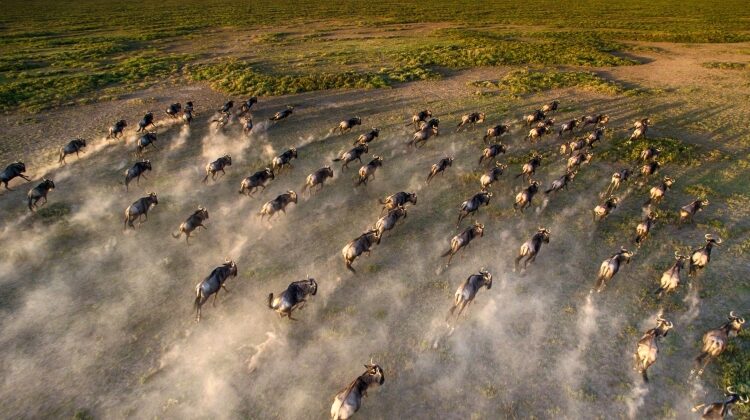
Whether you’re a safari novice or a wildlife addict, seeing the great wildebeest migration in Kenya or Tanzania is for you. This guide to the wildebeest migration walks you through what you can expect at every stage. The sights, sounds and smells of a vast number of wildebeest and zebra on the move, followed every step by hungry predators, is quite spectacular. Oxpeckers and egrets are seen in numbers during this time, taking advantage of the insects that the moving herds disturb. Watch thousands of anxious herbivores channelled into tight river crossing points, dodging the huge Mara River crocodiles waiting in their path. It’s an ancient battle of life and death, and one of the best wildlife shows on Earth.
‘One of the greatest shows on Earth’

Ride across the plains of the Serengeti National Park alongside the wildebeest migration
Although it looks like an evolutionary calamity, the wildebeest is one of Africa’s most prolific inhabitants and is perfectly suited to the Serengeti ecosystem that straddles the Kenya / Tanzania border. This is where the famous migration occurs, and where herds approaching two million wander between the southernmost parts of the Serengeti National Park, the Ngorongoro Conservation Area, and the Masai Mara to the north.

The migration follows a clockwise journey year by year, which tends to be influenced by rainfall and food availability. The herds, accompanied by several hundred thousand zebra, congregate on the short grass plains in the south just after Christmas to give birth and then make their way north via the west of the ecosystem towards Lake Victoria. During the journey, they may travel 40 miles in one day in a particular direction and then do the same in the opposite direction the following day. This is often the case during the rainy season when thunderstorms can be very localised but also quite heavy.
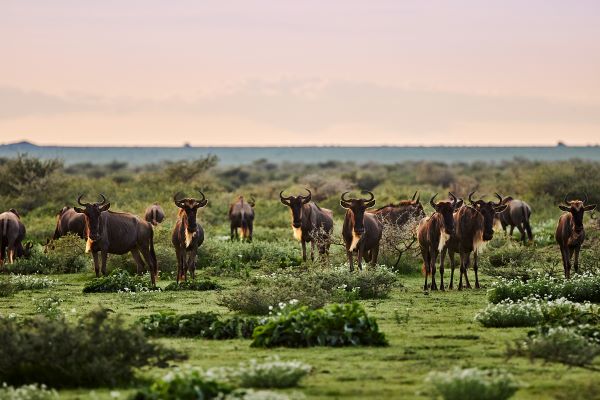
The wildebeest graze during dawn within the Serengeti
Our Guide to the Wildebeest Migration – when and where to go?
Calving and predator action – January, February, March
Head to the southern Serengeti and the Ndutu area, where you find the migration on the famous vast open plains. The visibility is superb, the cows are calving, and the predators are most visible at this time. Stay at Serengeti Safari Camp, a classic tented camp that moves seasonally to be in the best possible location for front row seats. Thrill-seekers can ride horses alongside the migration with Kaskazi Horse Safaris, shadowing their movement in mobile tented camps, which ensure you’re up close to the herds as they graze. I joined this ride in March, and the exhilaration of cantering alongside the massive herds of wildebeest and zebra is something that will stay with me forever.
View our 8 night Kaskazi Serengeti migration ride

Wildebeest calf spotted during Kaskazi Horse Safaris ride, Tanzania
Glorious isolation – April, May, June, and early July
Still in the Serengeti, the wildebeest have wandered into an area known as the western corridor. Between May and late June or early July the migration tackles the first crossing as it makes its way over the Grumeti River. Tucked away in a remote corner of the reserve and right on the riverbank is Grumeti Serengeti River Lodge – a perfect vantage point from which to view the excitement and chaos of a river crossing. It’s worth noting that April and May are the wettest months of the year. It’s still a beautiful time and there is a chance of having the migration almost to yourself.
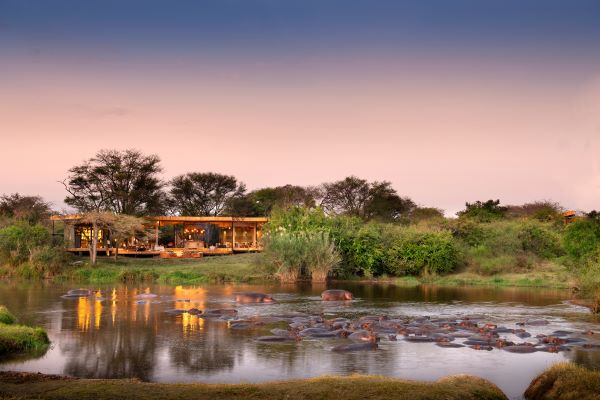
Grumeti Serengeti River Lodge in the western reaches of the Serengeti National Park, Tanzania
Mara River Crossings – August, September, October
For many, this is the pinnacle of the migration as the great herds dodge the huge crocodiles lying in wait as they stream across the Mara River, drawn to the lush grazing in the Masai Mara. It’s probably the migration at its most exhilarating, and among the best places to view our old favourites Cottar’s 1920s Camp and Lamai Serengeti, both with remote settings in prime locations, with the migration passing right by the door. This time of year, can be busy in the Masai Mara, and our favourite way to get away from the crowds while still enjoying the wildlife is by following the herds on horseback with Offbeat Riding Safaris. If you’d like to join our hosted ride across the Masai Mara with Austin O’Connor next September, do get in touch for more information.
View our 6 night Offbeat Riding Safaris Masai Mara migration ride
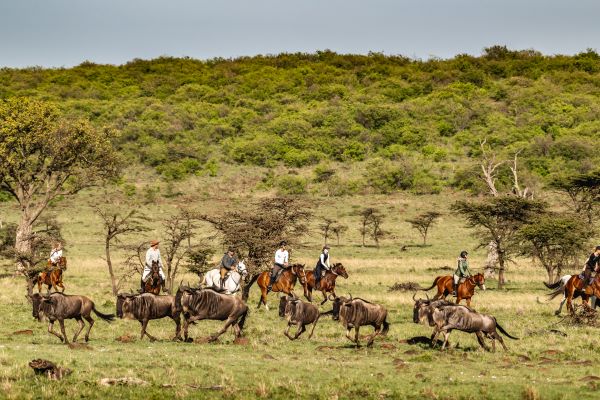
Offbeat Riding Safaris during wildebeest migration season in the Masai Mara, Kenya
Spectacular scenery – November/December
Now back in Tanzania, the herds travel south quite quickly and congregate in the central Serengeti, which is one of the most scenic parts of the National Park. Lemala Ewanjan, which from its hillside position offers staggering views of the migration, wildlife-filled grassland and vivid African sunsets, would be a super choice here.
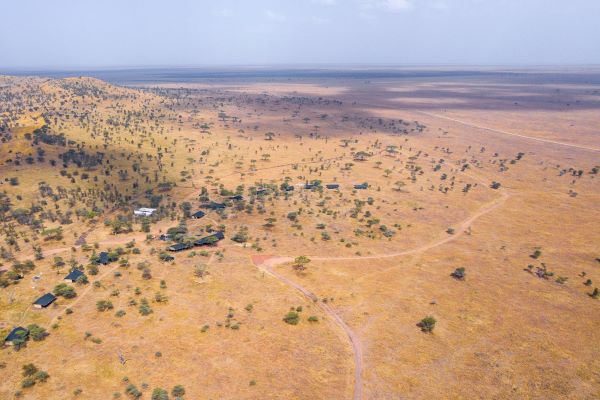
Lemala Ewanjan Tented Camp in the central Serengeti, Tanzania
The Great Wildebeest Migration is a powerful display of nature’s raw beauty, immense scale, and the fundamental struggle for survival. It’s a dynamic and ever-changing spectacle that leaves a lasting impression on all who witness it. I hope you have enjoyed reading our guide to the wildebeest migration. Feel free to ask any questions or comment below, we would be delighted to talk you through the many options available to you.
What next?
Get inspired and sign up to our free Insiders Guide to Africa. We would be delighted to help with planning your perfect safari holiday, whenever you want to travel. Our team of experts has travelled widely throughout Africa and the Indian Ocean and can offer expert advice. Do get in touch – chatting to people by phone or email is what we do best. We listen, we explain, we answer all sorts of questions even those you didn’t know to ask, and finally we make suggestions. If this is your first time to Africa or your twenty first, we have a team standing by to help make the planning easy and the journey the best ever. Please get in touch whatever stage you’re at.



Looks enticing
Dear Bernard, it is quite the remarkable experience. Please do let me know if you would like to chat further about the migration and I shall put you in touch with one of our experts. Best wishes, Maggie